
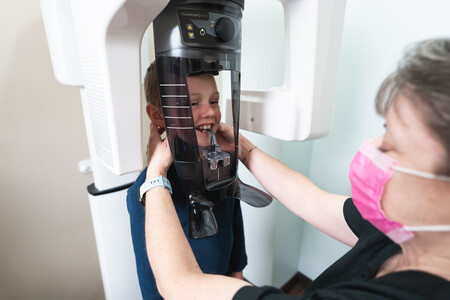
Dental Exams
Dr. Church prefers to begin dental exams around 8-10 months old. After this, a routine dental exam should take place once every 6 months for kids, teenagers and adults. At each visit, Dr. Church completes a thorough exam to be sure that proper growth and development of all oral structures is taking place. He also screens for oral cancer, potential orthodontic needs, gum disease, and for cavities or other issues with the teeth.
Dr. Church likes to screen early and often so he can catch issues while they are just beginning. This allows him more options of how to address it whether it is to monitor carefully, give specific home care instructions, and/or treat conservatively if needed. When a problem becomes large there are usually less options and urgent treatment is often needed.
Book OnlineX-rays
Dr. Church has a similar approach with x-rays as he does with exams, which is to be proactive with screening so he can be conservative with treatment. As part of this approach, Dr. Church recommends taking low radiation x-rays in high risk areas beginning at the age of 3 or 4 and then at least annually from there. Other needs may arise that would require additional x-rays such as an injury or to monitor small cavities for growth.
Screening early allows him more options of how to address issues that may arise whether it is to monitor carefully, give specific home care instructions, and/or treat conservatively if needed. When a problem becomes large there are usually less options and urgent treatment is often needed. Cavities between the teeth can be sneaky; if we wait until we can see them with the naked eye before taking an image, it often means it is too large to treat with a white composite filling.
Dental Cleanings
We know how challenging it can be to make sure our children are brushing and flossing adequately! Receiving a thorough cleaning from an experienced member of our team every 6 months is important. This way we can be sure we remove plaque and calculus from the areas your child may be missing. It also allows us to see how the gums react to being cleaned. We use all of this information to coach you and your child in how to improve at-home care when needed.
Fluoride or Hydroxyapatite Varnish
Dr. Church recommends the application of fluoride or hydroxyapatite varnish in the office at every 6 month appointment. This helps replace microscopic structural bonds in the enamel that may have been broken or weakened over time by wear-and-tear and diet. As long as it is used in the proper amount and frequency, the fluoride varnish is safe to use for all ages, though Dr. Church typically begins varnish placement at 2 years old.
Hydroxyapatite has become an excellent alternative for those concerned about using fluoride. Though still more randomized clinical trials are needed, research is showing that it can be as effective at reducing the rate of cavities. Because the scientific evidence is strong, Dr. Church and his team are happy to use hydroxyapatite varnish for any child in place of fluoride. He uses both types of varnishes on his own children.
If you would like to read more about Dr. Church’s thoughts on Fluoride or Hydroxyapatite, click on the associated links or feel free to ask him in person!
Dr. Church’s thoughts on Fluoride
Politics, religion, and now fluoride. This has become a hot topic! There is much to say on this subject. I will share a short version of my thoughts here, and I am always happy to chat more about it at the office!
Fluoride or Hydroxyapatite Varnish
Dr. Church recommends the application of fluoride or hydroxyapatite varnish in the office at every 6 month appointment. This helps replace microscopic structural bonds in the enamel that may have been broken or weakened over time by wear-and-tear and diet. As long as it is used in the proper amount and frequency, the fluoride varnish is safe to use for all ages, though Dr. Church typically begins varnish placement at 2 years old.
Hydroxyapatite has become an excellent alternative for those concerned about using fluoride. Though still more randomized clinical trials are needed, research is showing that it can be as effective at reducing the rate of cavities. Because the scientific evidence is strong, Dr. Church and his team are happy to use hydroxyapatite varnish for any child in place of fluoride. He uses both types of varnishes on his own children.
If you would like to read more about Dr. Church’s thoughts on Fluoride or Hydroxyapatite, click on the associated links or feel free to ask him in person!
Dr. Church’s thoughts on Fluoride
Politics, religion, and now fluoride. This has become a hot topic! There is much to say on this subject. I will share a short version of my thoughts here, and I am always happy to chat more about it at the office!
Short version:
I have a moderate view on fluoride. I believe when used at the proper time and in the proper amounts, it is safe and effective. I also believe that it is possible to live your entire life and never get a single cavity without drinking or using a drop of fluoride. Therefore, it should be treated as one helpful tool rather than a “must” for all individuals. I do recommend the in-office fluoride or hydroxyapatite varnish treatment every 6 months to kids 2 and older, because it does well to replace the structural bonds of enamel, and children are really good at weakening those in a variety of ways.
When it comes to fluoride toothpaste, I tailor the recommendation to the child and family. I do not think it is necessary for most children under 3 to use fluoride toothpaste. Avoiding it entirely or until they are a little older will help mitigate the risk of the child swallowing too much. For parents who want to use toothpaste for their young children, I would recommend hydroxyapatite toothpaste, or an option that does not have fluoride in it. For an older child who tends to get cavities easily, or who experiences sensitivity, I may prescribe a specific fluoride or hydroxyapatite toothpaste.
Fluoride in the water
I think it is perfectly fine not to have fluoride in the water for those who are able to take care of their teeth in other ways. As mentioned, fluoride is one tool, not the tool to use in preventing cavities. My concern with removing it is mainly for families living in poverty, because these are the families the research shows fluoride helps the most. I think it depends on the dental caries rate of the specific county considering removing fluoride from the water.
To summarize:
Fluoride pros:
It has been proven for decades to be a mineral that is excellent at restoring structural bonds on the enamel of all teeth.
Fluoride cons:
If used/consumed in excess (especially by pregnant mothers or young children) it could lead to fluoride toxicity (systemic issue) or fluorosis (localized tooth-related issue), both of which can cause permanent harm to the body, mind, and teeth.
Hydroxyapatite pros:
Thus far, research has shown it is likely as effective as fluoride in restoring enamel bonds.
The compound exists naturally in our body and there has not been any reports of negative side affects of ingestion and there does not seem to be any toxic level of consumption.
Hydroxyapatite cons:
We simply need more randomized clinical trials and more longitudinal studies showing its effectiveness.
If you would like to know more, I guess you’ll just have to make an appointment 🙂
Sealants
Sealants can be another excellent way to prevent cavities forming in high risk areas. Typically, a small amount of white sealant material will be placed in the grooves of the chewing surface of molars to disallow food and cavity-causing bacteria from accumulating. Sealants make the pits and rough surfaces smooth and glassy. The sealant material is similar to the material used for composite fillings. Not all children need sealants in order to remain cavity free, but it is an easy, minimally invasive and typically inexpensive option to consider. There are no shots and usually no drilling required to complete sealants. Dr. Church has had them placed in his children’s mouth (and his own) and has seen the benefits first hand. Because not all options are right for everyone, Dr. Church will give you his honest thoughts on whether your child would benefit from sealants.
Space Maintainers
If any teeth need to be removed with still years to go before its replacement will come through, it may be necessary to place a space maintainer in the area to prevent collapsing of the neighboring teeth. These maintainers are a fixed retainer cemented to an adjacent tooth and will be removed by the dentist or orthodontist when the desired permanent teeth begin to erupt. The space maintainers Dr. Church places are made of stainless steel.
Mouth Guards
For those who have all of their permanent teeth in and are involved in contact sports, it may be appropriate to use a custom mouth guard. Dr. Church and his team can make one for you in the office if desired.
FAQs
When should I bring my child in to see the dentist for the first time?
Dr. Church likes to see kids for their first dental visit around the time they begin getting their first teeth (Typically 8-10 months old). This allows Dr. Church to check for any oral abnormalities and get ahead of any potential issues. This also helps the child get used to the sights and sounds of a dental office early on so it can be normalized as early as possible. If parents are concerned about anything in their child’s mouth prior to 6 months, Dr. Church would be happy to see them sooner.
I am unsure if my infant has a lip or a tongue tie. Would it be too soon to bring them in soon after birth?
Not at all! Dr. Church frequently examines infants for oral structure concerns including lip and tongue ties. This is especially important if the child is having a tough time breast or bottle feeding. He can then discuss the need for a frenectomy to relieve the tie if applicable.
When should I bring my child in for their first dental visit?
Dr. Church prefers to see children for their first dental exam around the time they begin getting their first teeth, typically 8-10 months old. This helps check for abnormalities, get ahead of potential issues, and normalize the dental office environment early on.
How often should my child have a dental exam?
A routine dental exam is recommended once every six months for kids, teenagers, and adults.
My infant is having trouble feeding. Can I bring them in to check for a lip or tongue tie?
Yes, absolutely! Dr. Church frequently examines infants soon after birth for oral structure concerns, including lip and tongue ties, especially if they are having difficulty breastfeeding or bottle feeding. He can then discuss the need for a frenectomy if applicable.
What does the routine dental exam include?
Dr. Church performs a thorough exam to check for proper growth and development of all oral structures. He also screens for oral cancer, potential orthodontic needs, gum disease, and checks for cavities or other issues with the teeth.
When will my child start needing X-rays?
Dr. Church recommends starting low-radiation X-rays in high-risk areas beginning around the age of 3 or 4, and then at least annually from there.
Why are X-rays needed so early?
X-rays allow Dr. Church to be proactive and catch small issues like cavities between the teeth that are not visible to the naked eye. Screening early provides more options for conservative treatment or careful monitoring.
Why are professional dental cleanings necessary if we brush and floss at home?
Cleanings every six months ensure the removal of plaque and calculus from areas your child might be missing. It also allows our team to assess gum health and coach you and your child on improving at-home care.
What is the difference between Fluoride and Hydroxyapatite varnish?
Both are applied in the office to help restore microscopic structural bonds in the tooth enamel. Fluoride has been proven effective for decades, but if you have concerns, hydroxyapatite is a natural, safe alternative showing promising research as an equally effective treatment. Dr. Church is happy to use either option.
Does Dr. Church recommend Fluoride varnish for all children?
He recommends the in-office application of fluoride or hydroxyapatite varnish every 6 months for kids 2 years and older, as it is an excellent way to restore the structural bonds of enamel.
What are sealants?
Sealants are a thin, protective material (similar to a white filling) placed in the grooves of the chewing surfaces of molars. They smooth out the rough surfaces, preventing food and bacteria from accumulating and causing cavities.
Does placing a sealant require a shot or drilling?
No. Sealant placement is an easy, minimally invasive, and typically inexpensive option that usually requires no shots and no drilling.